
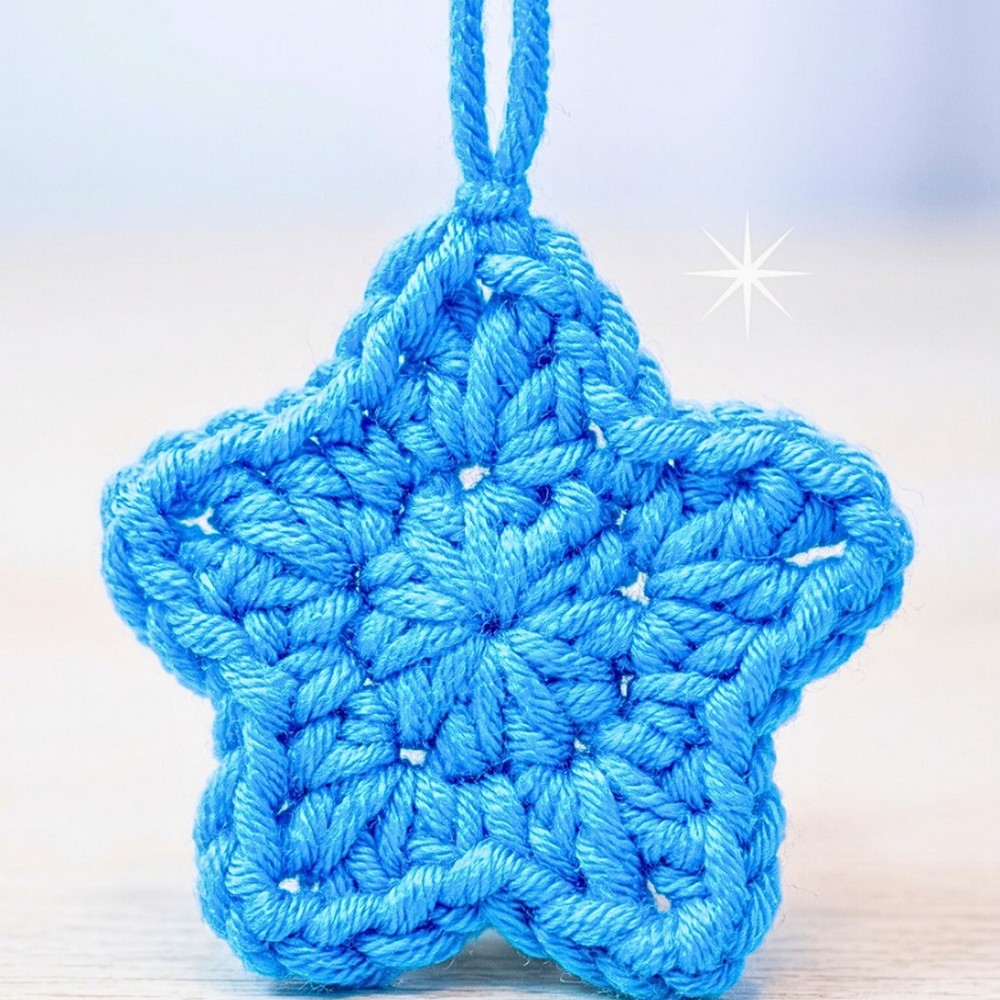
Those tiny five-point crochet stars take just two rounds, with a neat hanging loop that turns each one into a ready-to-use ornament or charm.

Five crisp points make this little crochet star instantly recognizable, while its tiny size means you can make several without needing much yarn. The built-in hanging loop is especially useful for turning the same simple shape into a Christmas crochet ornament, bag charm, keychain, or mobile decoration.
Only two crochet rounds are needed, but the second round is where the star takes shape. You’ll see exactly where each point begins, how the taller stitches create its peak, and how to move back to the first point to form the hanging loop. If you prefer a flat motif, simply weave the tail into the back instead of making the loop.
Credit SASAN
Materials & Tools
- Medium/worsted weight yarn: The tutorial uses pastel blue and purple.
- Crochet hook: Use a size appropriate for your yarn; the tutorial appears to use approximately a 3.5 mm hook.
- Tapestry or yarn needle: For weaving in ends and securing the hanging loop.
- Scissors: For trimming the yarn.
Finished Size & Ways to Use It
The pattern makes a small, bite-sized 5-point star. Its compact shape makes it useful for several different purposes without changing the crochet pattern itself.
Keep the long finishing tail to create a hanging loop for a keychain, bag charm, Christmas tree ornament, or baby mobile hanging. For a flat motif, skip the hanging loop and weave the tail completely into the back. The finished star can then be sewn onto hats, sweaters, blankets, or other crochet pieces as an applique.
Abbreviations
- MR: Magic Ring
- ch: Chain
- sc: Single Crochet
- hdc: Half Double Crochet
- dc: Double Crochet
- sl st: Slip Stitch
- st(s): Stitch(es)
Crochet the Star Center
Before the points appear, the first round creates a small circle of 10 hdc stitches. Keeping the starting chain separate from the stitch count makes the next round easier to follow.
Round 1: Make a MR, ch 1 to secure it, then work 10 hdc into the center of the MR (10 hdc); pull the short yarn tail firmly to close the center hole, then sl st into the first hdc to join.
After joining, look at the edge of your circle and count the actual hdc stitches. You should have 10 hdc, not 11—the beginning ch-1 does not count as a stitch.
This small circle is the entire base of the star. In the next round, those 10 stitches will be used in pairs: one stitch forms the lower part of each point, and the next stitch receives the taller stitches that create its peak.

Turn the Circle Into Five Star Points
Round 2 uses the same sequence repeatedly around the center. The important thing to notice is that each star point occupies two stitches from Round 1. Five points therefore use all 10 center stitches.
Round 2: Ch 1; in the first st work 1 sc; in the next st work [1 hdc, 1 dc, ch 2, 1 dc, 1 hdc] all in the same stitch; repeat this (1 sc in the next st, then [1 hdc, 1 dc, ch 2, 1 dc, 1 hdc] in the following st) x5 around; sl st into the first sc to join.
How the First Point Works
The first sc is deliberately simple. It brings the edge down before the taller stitch cluster rises in the following stitch.
Into that next stitch, all five elements—hdc, dc, ch 2, dc, hdc—go into the same stitch. Do not spread them across several stitches. The two double crochets create the height, while the ch-2 space forms the tip of the star.
After that cluster, the next sc begins the valley before the following point. Keeping this rhythm in mind makes the remaining four points much easier to locate.
Repeat Around the Star
Continue alternating: 1 sc in one stitch → complete tall point cluster in the next stitch.
Every point should use two stitches from the original 10-stitch circle. If you lose your place, check the center edge rather than counting the taller stitches individually.
By the end of Round 2, you should have 5 clearly visible points around the center. The ch-2 space at each peak should sit at the outer tip, while the sc stitches create the lower spaces between neighboring points.
Finish by making a sl st into the first sc of Round 2.

Create the Hanging Loop
The loop is made from the tip of the first star point, so you do not need to crochet a separate chain beforehand.
After joining Round 2, work 3 sl sts up the side of the first star point until your hook reaches the top ch-2 space.
Once you are positioned at the tip, fasten off while leaving a long yarn tail. This tail becomes the hanging string.
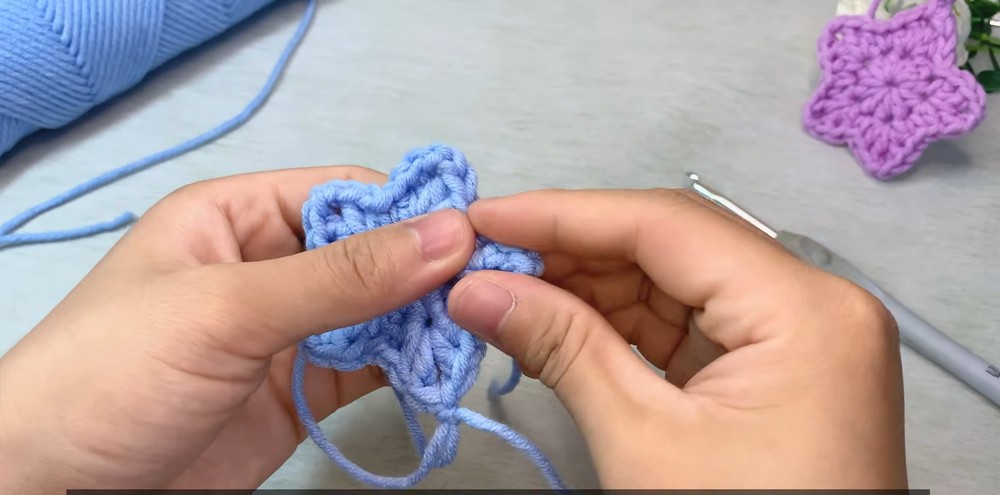
Thread the long tail onto your tapestry needle and form the loop to your preferred length. Bring the base of the loop back to the tip of the same star point and sew it securely in place.
The loop should sit directly above the point rather than pulling the star sideways. If it looks uneven, adjust its length before hiding the remaining yarn.
Finish the Star
Weave the remaining yarn ends through the stitches on the back of the star. Work the needle through several stitches rather than trimming immediately, especially around the base of the hanging loop where the yarn receives the most movement.
Once the ends are secure, snip away the excess yarn.
For an applique, simply weave the finishing tail completely into the back instead of forming the loop.
Final Shape Check
Lay the star flat and gently spread each point with your fingers. You should see five evenly spaced points, with a ch-2 space at the tip of each one and a small dip between neighboring points.
If one point looks smaller, first check that all five tall stitches were worked into the same base stitch. If the center looks loose, make sure the original magic ring was pulled closed firmly.
Your tiny crochet star is now ready to become a festive ornament, keychain, bag charm, mobile hanging, or flat applique. Since the complete shape takes only two rounds, changing the yarn color is an easy way to make a whole set of coordinating stars.



One Comment