Make a cheerful rainbow crochet coaster with colorful arches and fluffy white cloud scallops, using clear row-by-row guidance for shaping each curve.
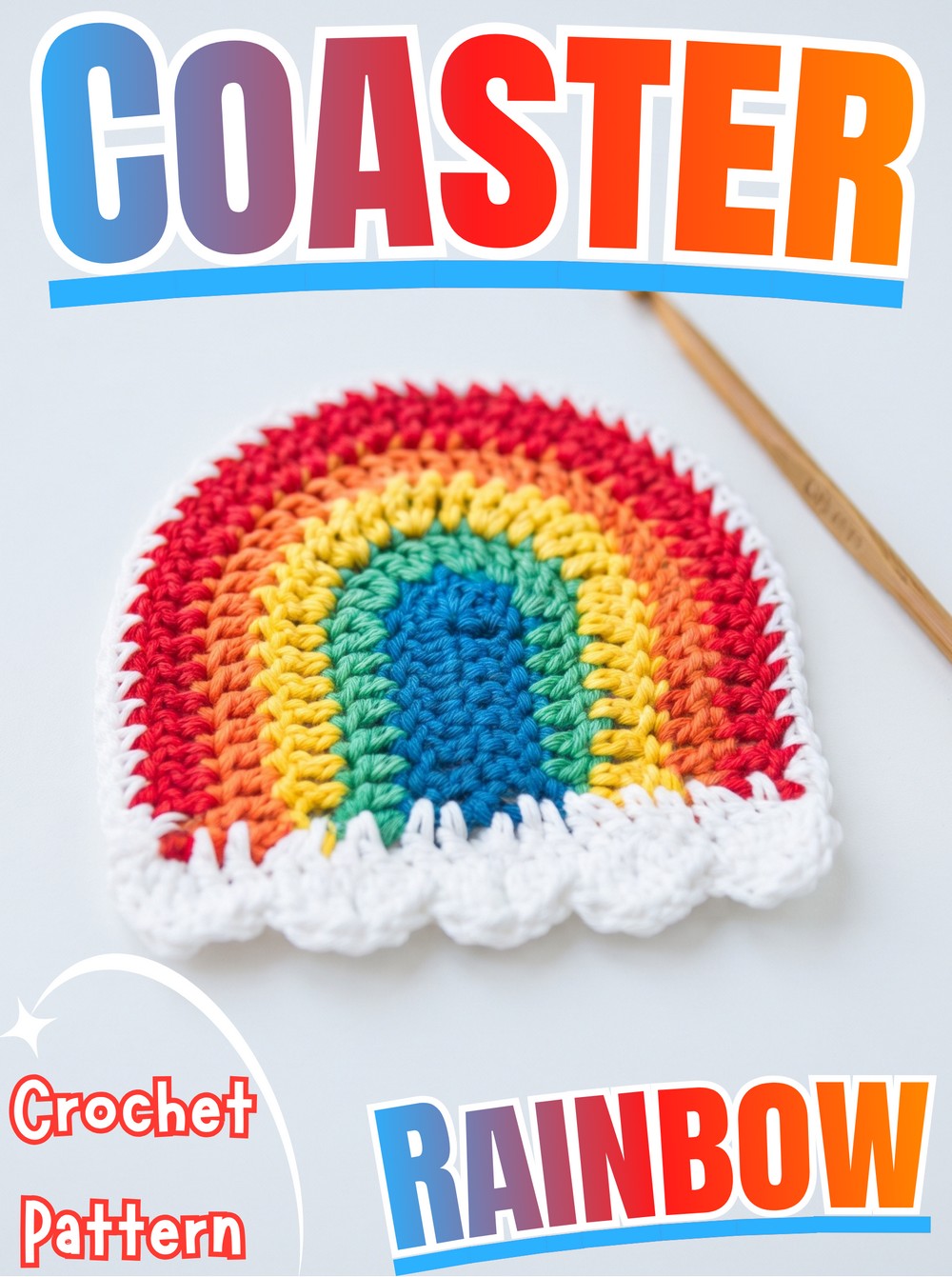
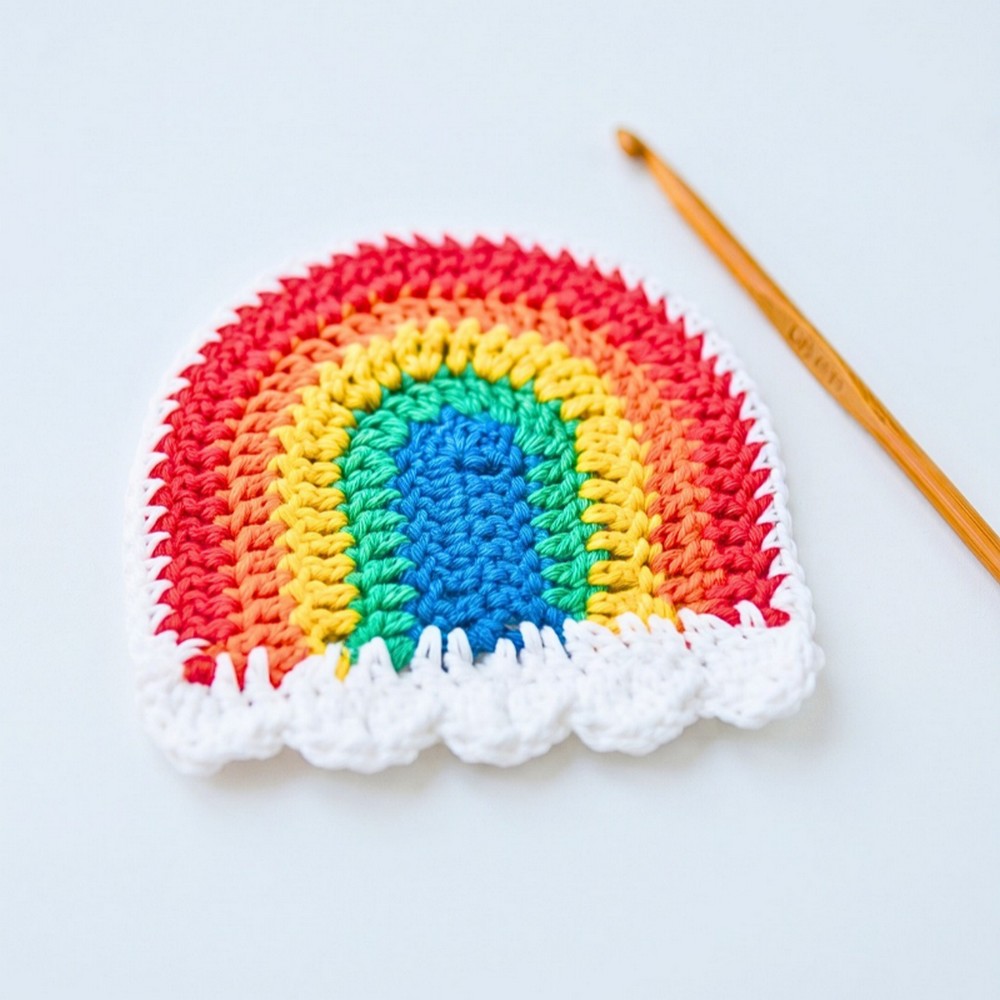
Add a pop of color to your table with a rainbow crochet coaster finished with soft-looking white cloud scallops. Five bright bands in blue, green, yellow, orange, and red form the rainbow, while the white edging frames its curved shape and adds a playful finish. This crochet rainbow also makes a thoughtful handmade gift, a cheerful desk accessory, or a fun addition to a colorful table setting.
This step-by-step crochet tutorial guides you through shaping the rainbow one color at a time, adding a neat white outer edge, and forming five cloud scallops along the bottom. You will learn how to work the curved increases, join each new color, and finish the coaster neatly with woven-in ends. An optional felt backing can cover the underside and help the finished crochet piece sit more securely on a tabletop.
Credit: Crochela
Materials & Tools Needed
- Yarn: DK or sport-weight cotton yarn in six colors:
- Blue for the inner arch
- Green
- Yellow
- Orange
- Red for the outer arch
- White for the outer border and cloud scallops
- Crochet Hook: 3.0-3.5 mm
- Tapestry or Yarn Needle: For weaving in yarn ends
- Scissors: For cutting yarn
- Optional Backing: Craft felt and hot glue or fabric glue
Pattern Abbreviations & Terminology
- ch: Chain
- sl st: Slip stitch
- sc: Single crochet
- dc: Double crochet
- st/sts: Stitch/stitches
- sk: Skip
- ch-sp: Chain space
This pattern uses US crochet terminology.
Check the Foundation Chain
The original Row 1 instructions say to chain 16, work a double crochet into the fourth chain from the hook and the next five chains, work the curved increases across four more chains, and then work six double crochets along the other straight side. Those instructions do not fit together as written: after skipping three chains, a chain of 16 provides only 13 chain positions, but the described sections require 16 working positions.
Teaching guide – how to resolve the count: If you want to retain the stated sections of six stitches, four curved stitches, and six stitches, the foundation chain needs 19 chains: three skipped chains plus 16 working positions. Work the first six double crochets, then the four curved increases, and then the remaining six double crochets as described. This produces 22 double crochets in total, including the starting chain-3 counted as a double crochet, rather than the stated 23.
This is the arithmetic correction that makes the written stitch sections fit. However, because the original instructions also describe working “down the other side,” the original video or a clear image of Row 1 should be checked before publication to confirm the intended direction of the stitches and the final shape. Do not publish the original chain-16 instruction alongside the six-plus-four-plus-six count without resolving this mismatch.
How to Crochet the Rainbow Coaster
Row 1: Blue Inner Arch
- Make a slip knot and chain 19 if following the corrected six-plus-four-plus-six stitch layout explained above.
- Work a double crochet into the fourth chain from the hook. Make one double crochet in each of the next five chains, giving you six double crochets in the first straight section. The beginning chain-3 counts as the first double crochet.
- Shape the curve by working the following increases into the next four chain stitches:
- 2 dc in the next chain
- 3 dc in the next chain
- 3 dc in the next chain
- 2 dc in the next chain
- Work one double crochet into each of the remaining six chain positions to complete the second straight section.
- Fasten off the blue yarn and cut it, leaving a tail long enough to weave in.
Teaching guide – check the arch before continuing: The curved section should have more stitches than the straight sections, creating a rounded end rather than a sharp corner. Count the stitches in each section separately. With six stitches on each straight section and ten double crochets in the curve, the written layout totals 22 double crochets. If the shape does not resemble a smooth arch, check the original video or reference image before continuing to the next color.
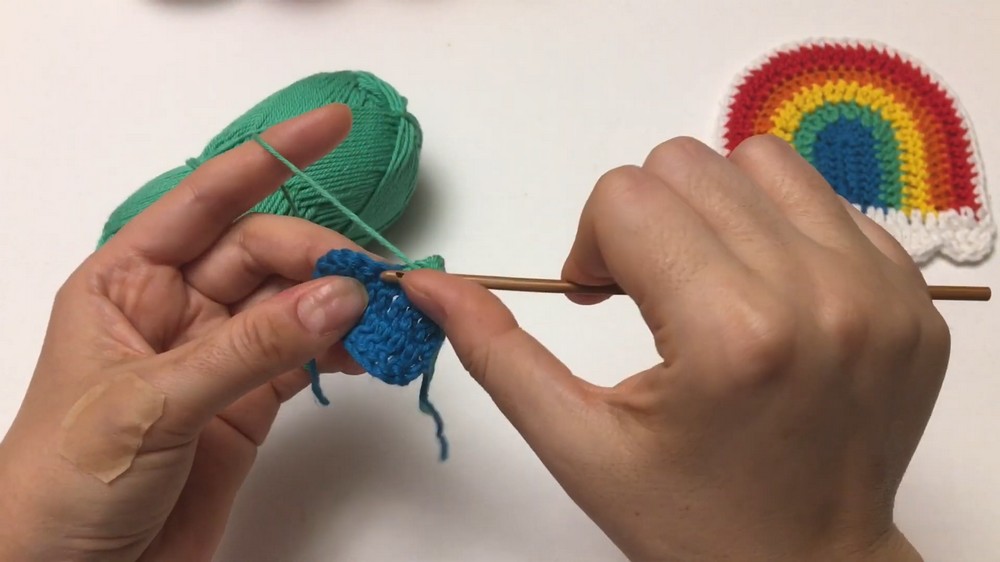
Row 2: Green Arch
- Join the green yarn at the top of the beginning chain-3 of Row 1.
- Chain 3. This chain counts as the first double crochet. Work one double crochet into each of the next six double crochets along the straight section, following the source pattern’s placement.
- Across the curved section, repeat (2 dc in the next stitch, 1 dc in the next stitch) five times.
- Work one double crochet into each of the remaining six double crochets along the other straight section.
- Fasten off and cut the green yarn.
Teaching guide – why the curve repeat is five times: The first row’s curved section contains four base stitches. The green instruction works into those four stitches only if the increases are distributed according to the actual curve shown in the source; the written repeat of five uses ten base stitches. This is another point that needs checking against the original row layout before publication. Do not force five repeats into four stitches. Confirm how many stitches belong to the curve in the intended Row 1, then repeat the green increase sequence across that section without skipping or reusing stitches.
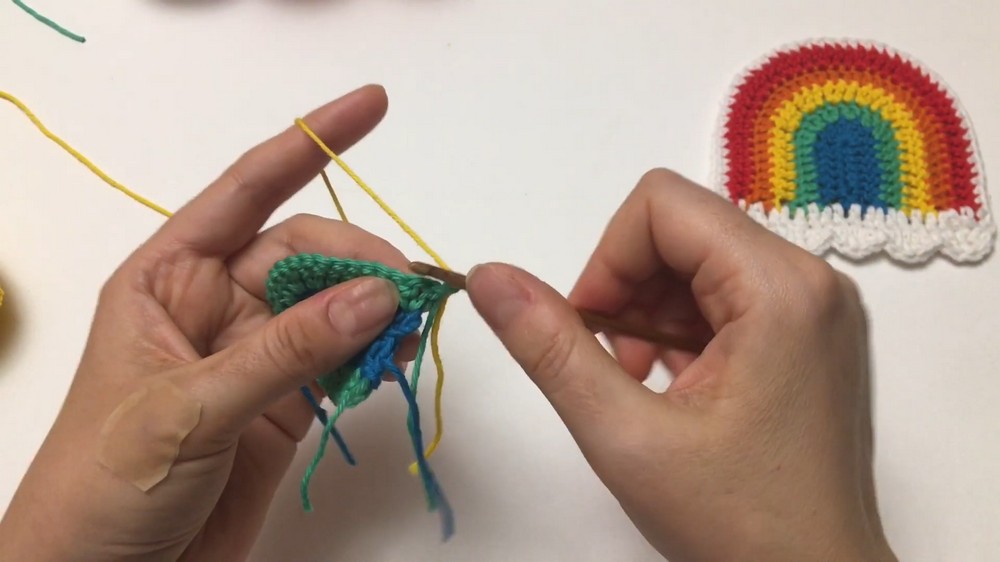
Row 3: Yellow Arch
- Join the yellow yarn at the top of the turning chain-3 from Row 2.
- Chain 3, counting it as the first double crochet. Work one double crochet into each of the next six double crochets along the straight section.
- Across the curve, work (2 dc in the next stitch, 1 dc in each of the next two stitches). Repeat this sequence across the curved section, following the confirmed stitch count from Row 2.
- Work one double crochet into each stitch along the remaining straight section.
- Fasten off and cut the yellow yarn.
Teaching guide – how to find the repeat count: Each repeat uses three stitches from the previous row: one stitch for the increase and two stitches for single double crochets. Count only the stitches that belong to the curved section, then divide that number by three. If the curve contains 15 stitches, the sequence is repeated five times. If the count does not divide evenly, check the previous row before proceeding rather than placing an increase wherever it seems to fit.
The increases should make the yellow band wider while keeping the arch flat. If the edge begins to cup, the curve may not have enough increases; if it develops ruffles, there may be too many.
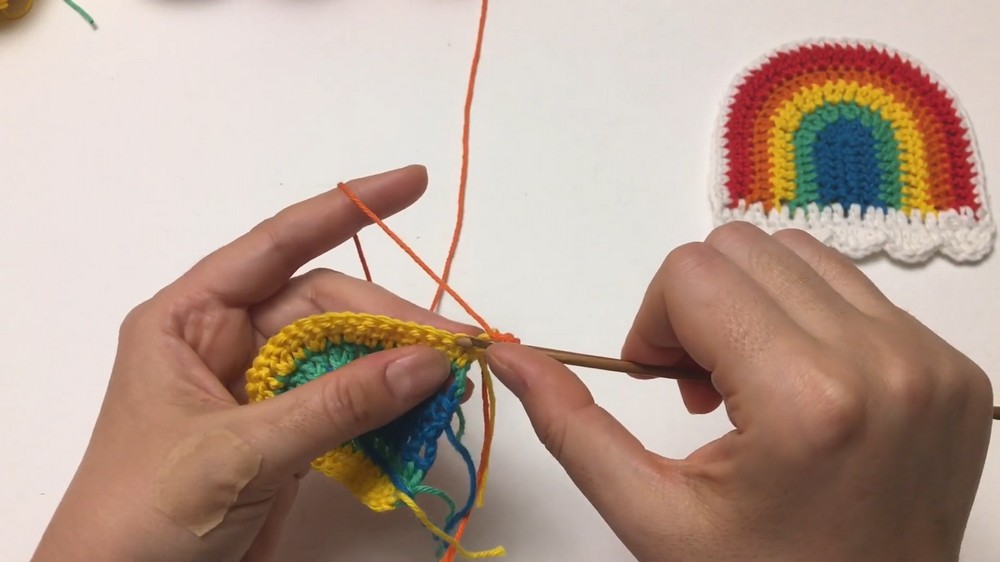
Row 4: Orange Arch
- Join the orange yarn at the top of the turning chain-3 from Row 3.
- Chain 3, counting it as the first double crochet. Work one double crochet into each of the next six double crochets along the straight section.
- Across the curve, work (2 dc in the next stitch, 1 dc in each of the next three stitches). Repeat across the curved section using the confirmed number of stitches from Row 3.
- Work one double crochet into each stitch along the remaining straight section.
- Fasten off and cut the orange yarn.
Teaching guide – check before fastening off: Each orange repeat uses four stitches from the previous row. Count the curve stitches before starting the sequence. For example, if Row 3 leaves 20 stitches along the curve, work the sequence five times. Keep the straight sections even on both sides so the orange band follows the yellow arch without leaning to one side.
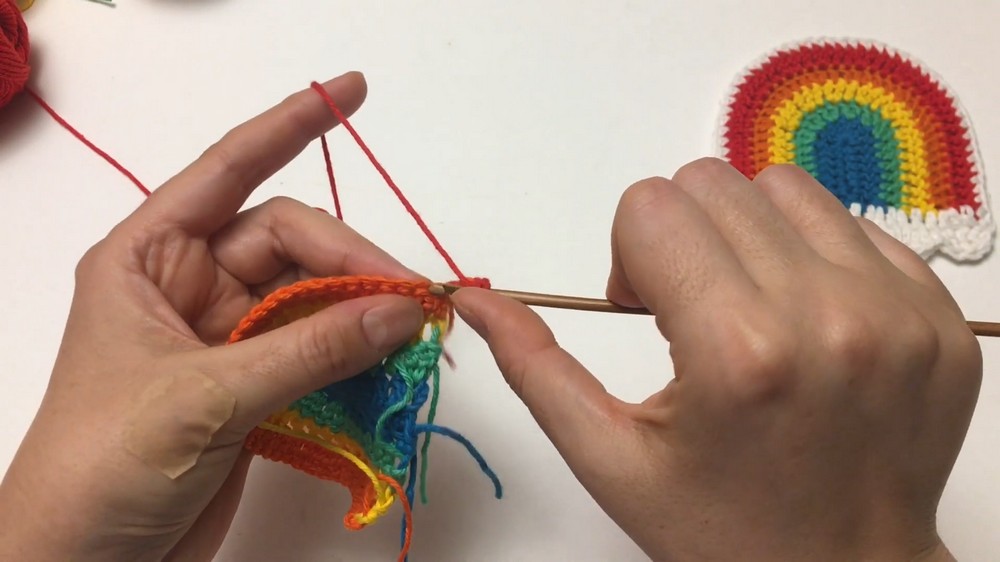
Row 5: Red Outer Arch
- Join the red yarn at the top of the turning chain-3 from Row 4.
- Chain 3, counting it as the first double crochet. Work one double crochet into each of the next six double crochets along the straight section.
- Across the curve, work (2 dc in the next stitch, 1 dc in each of the next four stitches). Repeat across the curved section according to the confirmed stitch count from Row 4.
- Work one double crochet into each stitch along the remaining straight section.
- Fasten off and cut the red yarn.
Teaching guide – calculating the repeat: Each red repeat uses five stitches from the previous row. If the curved section contains 25 stitches, repeat the sequence five times. Count the curve stitches before beginning, and place a marker at each end of the curved section if it is difficult to tell where the straight side finishes. This helps keep increases within the curve rather than accidentally widening the straight legs.
The red band should form the widest rainbow arch. Lay the piece flat before moving on. The colored bands should sit smoothly beside one another, without curling sharply or forming loose ruffles.
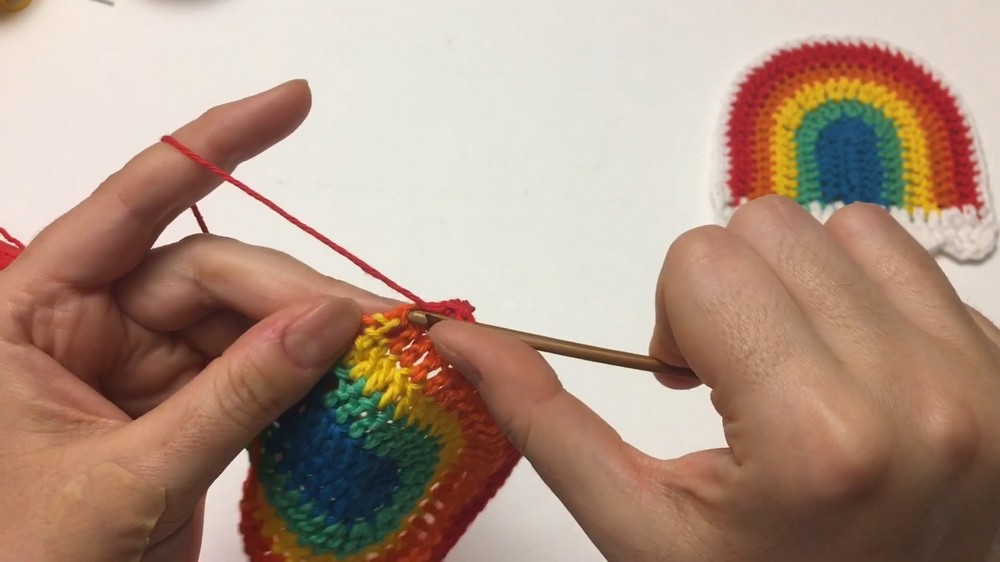
White Border and Cloud Base
Work the Outer Edge
- Join the white yarn at the bottom outer corner of the red row.
- Chain 1, then work single crochet stitches evenly around the outer curved edge of the red arch.
- At the corners, work two single crochets where needed to help the border turn smoothly.
- Continue to the opposite bottom corner.
Teaching guide – how to keep the border smooth: Avoid placing too many single crochets in one spot, as this can make the edge ruffle. If the border pulls inward, add a stitch where the curve needs more room. If it waves outward, remove an unnecessary extra stitch and spread the remaining stitches evenly. The goal is a flat edge that follows the red arch.
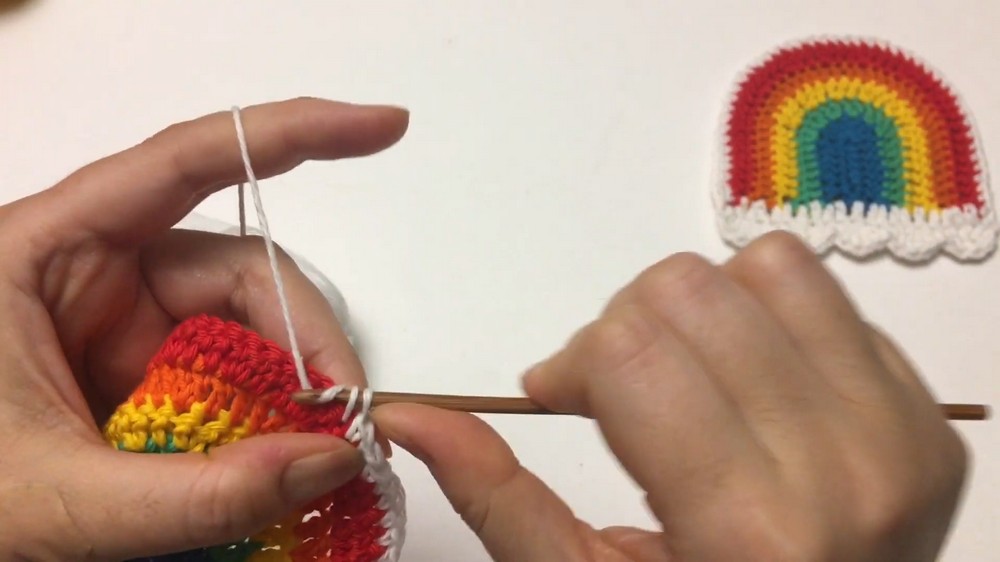
Add the Cloud Scallops
- Turn the work and crochet across the flat bottom edge, spanning both straight legs and the central gap.
- Make five cloud scallops across the bottom using this sequence: skip 1-2 stitches, work 5 dc in the next stitch, skip 1-2 stitches, then sl st into the next stitch.
- Repeat the scallop sequence five times, spacing the shells evenly across the bottom edge.
- Join with a slip stitch, cut the yarn, and fasten off.
Teaching guide – spacing five scallops evenly: Before making the shells, identify the full stretch of the bottom edge and divide it visually into five sections. Each shell should sit inside one section, with a slip stitch anchoring the dip between shells. The instruction allows skipping one or two stitches, so choose the spacing that fits the actual number of stitches along your edge. Keep the same spacing as consistently as possible; do not squeeze a shell into the final gap if doing so would make the clouds crowded.
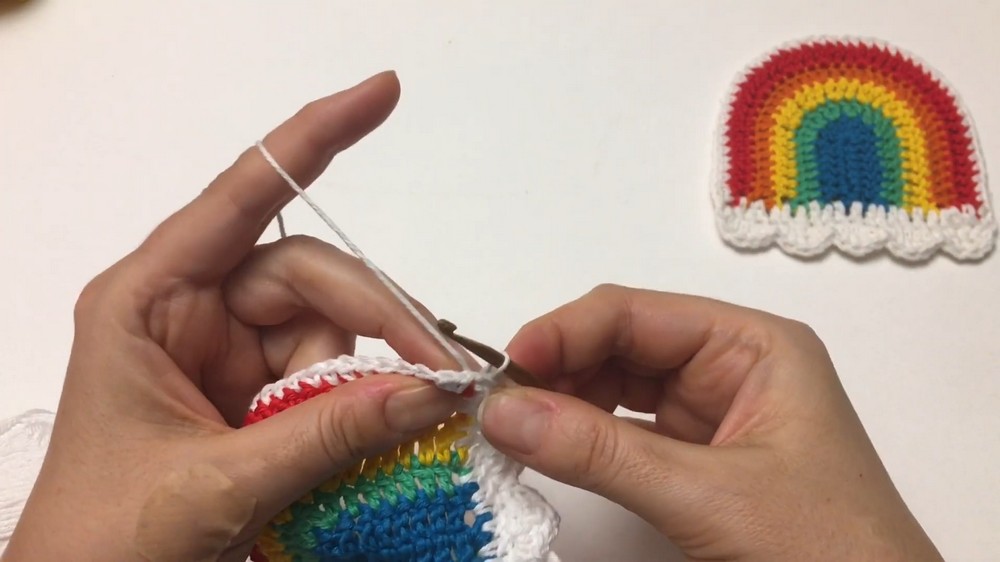
Finishing the Rainbow Coaster
- Thread the tapestry needle with each yarn tail and weave the ends securely into the wrong side of the stitches.
- Trim any excess yarn after the ends are secured.
- If you want a backing, place the coaster on craft felt and trace around its shape.
- Cut the felt slightly inside the outer border so it will not show around the edge.
- Attach the felt with hot glue or fabric glue, keeping the glue away from the visible stitches. Allow it to set according to the glue instructions before using the coaster.
Troubleshooting: Keep the Rainbow Flat
- The arch curls upward: Check that each row has enough increases along the curved section. Recount the base stitches and make sure every repeat uses the intended number of stitches.
- The curve looks wavy or ruffled: Too many increases may be crowded into the curve. Check the stitch count and remove any accidental extra increases.
- One side looks longer than the other: Count the stitches along both straight sections and make sure the same number is worked on each side.
- The white edge looks uneven: Space the single crochet stitches evenly, using extra stitches at corners only when needed.
- The cloud shells look crowded: Adjust the skip spacing between shells so all five scallops fit across the bottom edge without overlapping.